
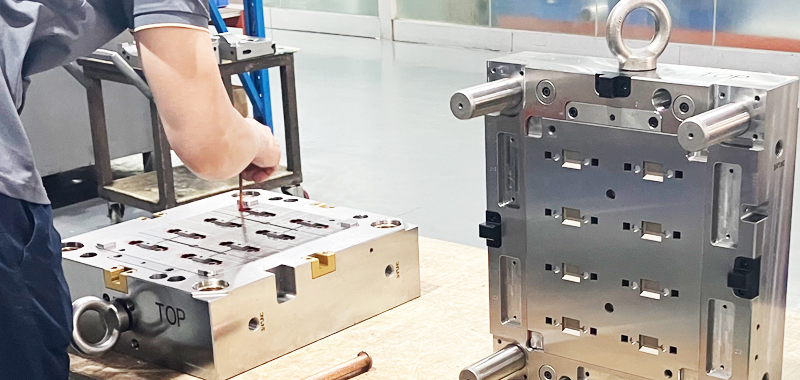
China remains the world’s dominant hub for plastic injection mold manufacturing, producing an estimated 40-50% of the world’s molds across every industry segment. For buyers in Europe, North America, and the Middle East, sourcing molds from China offers significant cost advantages—often 30-50% lower than domestic alternatives—without sacrificing quality, provided you select the right partner.
But “China” is not a monolith. The gap between a world-class precision mold maker in Shenzhen or Dongguan and a small workshop producing low-end commodity molds is enormous. Choosing incorrectly can result in delayed timelines, quality failures, communication breakdowns, and total project loss.
This checklist provides a systematic, step-by-step framework for evaluating plastic mold suppliers in China. It covers capability verification, quality systems, communication, commercial terms, and risk management—everything you need to make a confident sourcing decision.
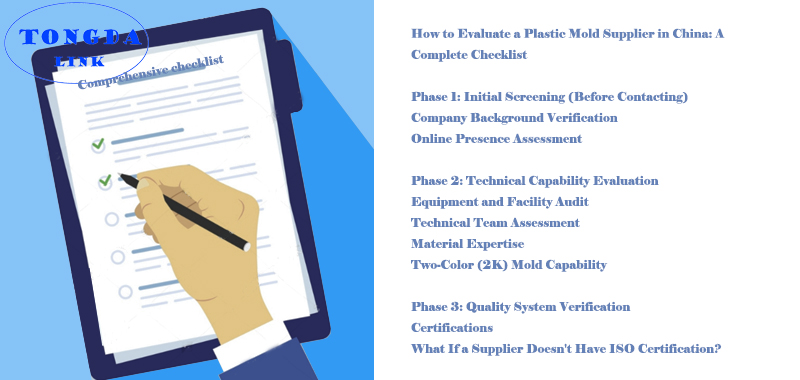
Phase 1: Initial Screening (Before Contacting)
Before you send a single RFQ, conduct desk research to filter out suppliers who clearly do not match your requirements.
Company Background Verification
- Business license and registration: Verify the company’s legal registration through China’s National Enterprise Credit Information Publicity System . Check the registered capital, establishment date, business scope, and any legal disputes.
- Years in business: Prefer suppliers with 5+ years of operation. Mold making requires accumulated expertise that newer companies may lack.
- Company size vs. your project: A 50-person precision mold shop can comfortably handle 300-400 complex molds per year, while a 200-person factory may be better suited for high-volume commodity mold production. Match scale to project complexity, not just headcount. A focused team of 50 skilled technicians often outperforms a larger factory with less specialized expertise.
- Industry focus: Look for suppliers whose stated specialties align with your industry (automotive, medical, electronics, consumer goods). A shop that does “everything” often excels at nothing. However, a supplier that focuses on a specific precision niche—such as EDM machining, complex core mechanisms, or mirror-finish cavities—can deliver results that larger general-purpose factories cannot match.
Online Presence Assessment
- Website quality: A professional website with detailed capability descriptions, equipment lists, and case studies indicates a company that invests in its image and processes.
- Certifications displayed: ISO 9001, IATF 16949 (automotive), ISO 13485 (medical), ISO 14001 (environmental)—these should be prominently displayed and verifiable. However, do not eliminate a supplier solely based on the absence of certifications. Many highly capable precision mold makers—particularly smaller, specialized shops—operate without formal ISO certification but maintain rigorous quality standards through documented processes, in-house inspection, and transparent trial workflows. We address this in detail in Phase 3.
- Case studies and portfolio: Real project photos, material specifications, and application descriptions demonstrate actual experience. Technical videos showing actual machining processes, mold trials, and finished parts can be even more convincing than static photos, as they demonstrate real-world capability.
- Red flags: Stock photos instead of real factory images, vague capability claims (“we can do anything”), no specific equipment or material mentions.
Phase 2: Technical Capability Evaluation
This is the most critical phase. You need to verify that the supplier has the actual equipment, expertise, and track record to deliver your specific project.
Equipment and Facility Audit
Ask for a detailed equipment list and verify the following:
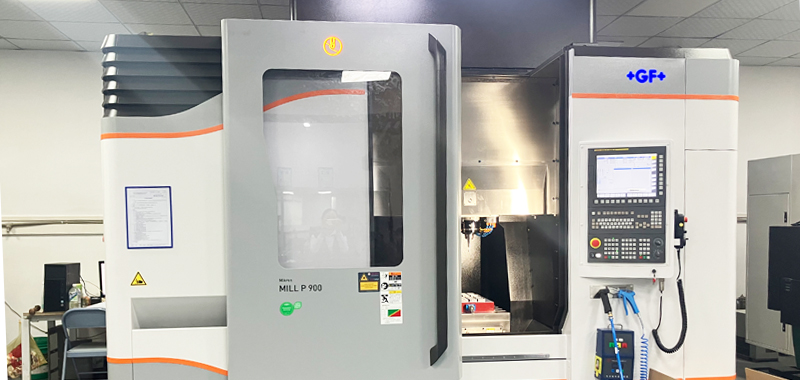
- CNC machining centers: How many? What brands (Mazak, DMG Mori, Makino, Hermle, Mikron)? What is the maximum travel size? What is the positioning accuracy? A supplier operating Swiss-made Mikron CNC machining centers demonstrates a serious commitment to precision. Mikron machines feature mineral casting bases that absorb vibrations 8x better than cast iron, active thermal control systems maintaining coolant temperature within ±0.1°C, and high-speed spindles up to 42,000 RPM with runout below 0.5μm. These capabilities enable consistent machining accuracy of ±0.005mm on complex mold geometries—including hardened steels above 60 HRC—making them indispensable for precision mold cavities, fine electrodes, and complex 3D surfaces that standard CNC mills simply cannot achieve.
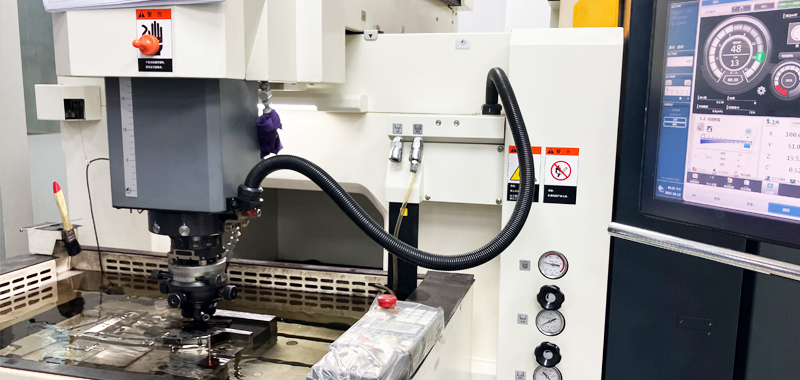
- EDM machines: Sinker EDM and wire EDM capabilities. Brands matter—Sodick, Charmilles, Mitsubishi, Makino are industry leaders. Ask specifically about positioning accuracy (e.g., ±0.002mm) and surface finish capability (e.g., mirror-finish Ra 0.1μm). A supplier operating Makino EDGE3i with adaptive discharge control, for example, can consistently hold ±0.002mm on complex cavities—a clear indicator of precision capability. The combination of Mikron CNC for high-speed precision milling and Makino EDM for fine surface finishing represents a complete precision machining chain. When a supplier owns both, they can machine complex mold geometries from raw steel to mirror-finish cavity without outsourcing any step—reducing cumulative tolerance stack-up and shortening lead times.
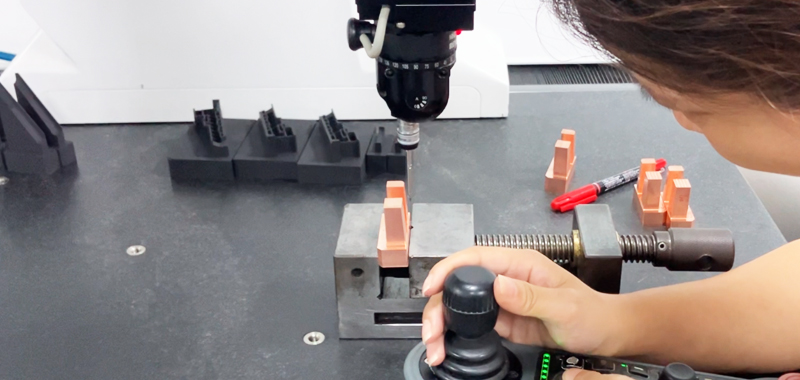
- Measurement equipment: CMM (brand and accuracy), optical comparators, surface roughness testers, hardness testers. A supplier without a CMM cannot verify precision work. Look specifically for high-precision CMMs such as the CROMA series (manufactured by Serein, a Hexagon Group company). CROMA CMMs feature an all-aluminum frame with precision triangular beam design, high-precision self-cleaning air bearings on all three axes, and European-imported linear encoders with 0.078μm resolution. The measurement accuracy (MPEe) of 2.8+L/300 μm ensures reliable verification of tight-tolerance mold components. Equipped with industry-standard PC-DMIS measurement software, CROMA CMMs can generate comprehensive dimensional reports including GD&T analysis, surface profile comparison, and statistical process data—providing the documented proof of precision that serious buyers require. A supplier investing in a CROMA CMM signals that they treat measurement as a core capability, not an afterthought. This is the difference between a shop that “checks” dimensions and one that “verifies and documents” them.
- Injection molding machines: For in-house trial capability. What tonnage range? Do they have servo-electric machines for precision molding? Do they have a two-color (2K) machine if your project requires it?
- Auxiliary equipment: Dryers, chillers, cooling towers, clean rooms (for medical molds), robotic arms for automated part removal.
- Maximum mold size and weight capacity: Ensure the facility can physically handle your mold’s dimensions.
Want to See Our Equipment in Action?
We’ll send you a detailed equipment capability report along with sample CMM inspection data and mold trial videos from recent projects — so you can evaluate our precision before sending an RFQ.
Request Equipment ReportTechnical Team Assessment
- Mold designers: How many? What CAD/CAM software do they use (UG/NX, SolidWorks, Creo, CATIA)? Do they perform mold flow analysis (Moldflow, Moldex3D)?
- Process engineers: Who sets up the injection molding parameters? Do they have experience with your specific resin type?
- Quality engineers: Who performs CMM inspection and first article approval? What is their reporting format?
- Project managers: Will you have a dedicated English-speaking project manager? What is their response time? In a 50-person precision shop, the project manager may also be a senior engineer or the business owner directly—this is actually an advantage, as you get direct access to technical decision-makers rather than being passed through multiple layers of communication.
Material Expertise
Ask specific questions about their experience with your target material:
“Have you molded PEEK before? What mold temperatures and injection pressures did you use?”
“What is your experience with glass-filled nylon? How do you handle fiber orientation and weld line strength?”
“Have you worked with medical-grade silicone or LSR? What clean room class do you maintain?”
A supplier who can answer these questions with specific parameters and real examples has genuine expertise. Vague answers indicate limited experience.
Guide to Selecting ThermoplasticTwo-Color (2K) Mold Capability
As multi-material and multi-color plastic products become increasingly common across automotive, consumer electronics, medical devices, and household appliances, the ability to manufacture two-color (2K) molds has become a critical differentiator for mold suppliers.
When evaluating a supplier’s 2K capability, ask specifically about:
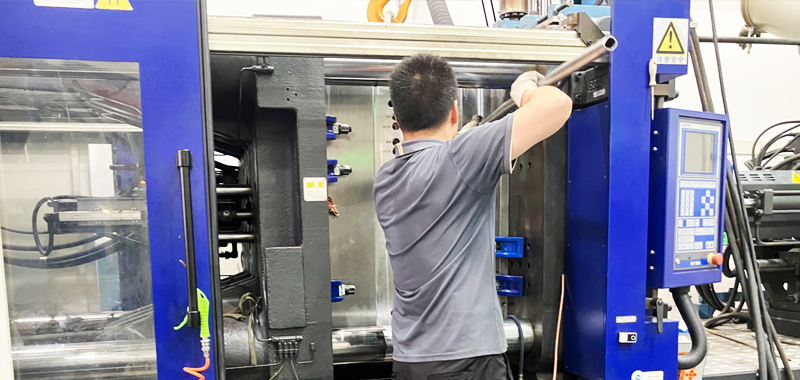
- In-house two-color injection molding machines: Does the supplier own dedicated 2K machines for mold trial and validation? A supplier operating Haitian two-color injection molding machines—such as the IAⅡ series with dual servo-motor-driven rotary tables—can validate mold performance in-house before delivery. Haitian’s 2K machines feature rotary table control precision of 0.005° and mold opening repeatability of ±0.5mm, ensuring reliable two-shot molding trials.
- Rotary mold design experience: Two-color molds require precision rotary mechanisms (turntable or core-back designs) with tight alignment between the first and second shots. Ask for examples of 2K molds they have built, including parting line alignment accuracy and rotary positioning repeatability.
- Material compatibility expertise: Different material combinations (e.g., PC/ABS, TPE/PP, PA/TPU) require specific mold temperature controls, gate designs, and shrinkage compensations. A supplier with proven 2K experience can advise on optimal material pairings and process parameters.
- Mold trial documentation: Request trial videos showing the complete two-shot cycle—first injection, rotary table rotation, second injection, and part ejection. This demonstrates that the mold functions correctly as a system, not just as individual cavities.
A supplier that owns in-house 2K injection molding capability can perform complete mold trials, identify issues, and optimize parameters before shipping the mold to you—significantly reducing the risk of costly rework after delivery. This is particularly valuable for overseas buyers who cannot easily travel to China for multiple trial iterations.
Phase 3: Quality System Verification
Certifications
ISO 9001: Basic quality management system. This is table stakes—any serious supplier should have it.
IATF 16949: Required for automotive industry suppliers. This standard includes additional requirements for APQP, PPAP, FMEA, and SPC.
ISO 13485: Required for medical device mold suppliers. Includes clean room requirements, traceability, and validation protocols.
ISO 14001: Environmental management. Increasingly required by European and North American OEMs.
Important: Do not just accept a certificate image. Verify the certificate number on the issuing body’s website (e.g., SGS, TÜV, BSI, DNV).
What If a Supplier Doesn’t Have ISO Certification?
Not every capable mold maker holds formal ISO certification—particularly smaller, specialized shops that focus on precision over volume. In fact, many excellent precision mold makers in China operate without ISO certification but maintain rigorous quality standards through alternative means.
When evaluating a supplier without ISO certification, look for these alternative indicators of quality capability:
- Documented quality processes: Ask for their quality manual or quality control workflow document. Even without ISO certification, a professional shop should have written procedures for incoming inspection, in-process inspection, and final inspection.
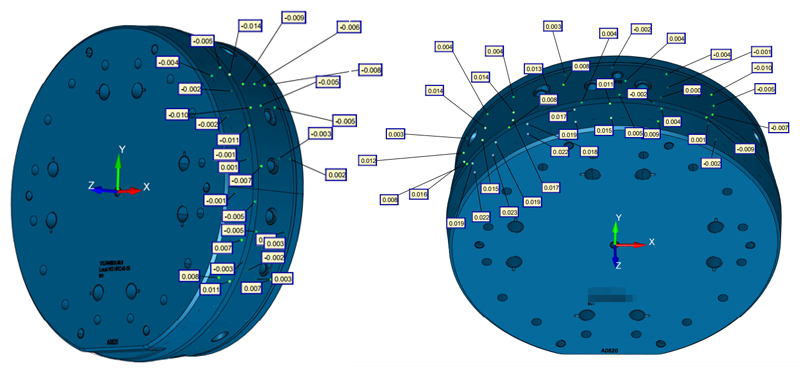
- In-house CMM inspection with full dimensional reporting: The ability to produce CMM reports on every mold is a stronger indicator of quality capability than a certificate on the wall.
- Transparent trial process with video documentation: A supplier who proactively shares mold trial videos and inspection data demonstrates confidence in their quality.
- Willingness to accept small test projects: A capable supplier should have no hesitation in starting with a small test mold to prove their capability before you commit to a larger project.
- Remote or on-site factory audits: If a supplier welcomes factory visits or remote video audits, it signals transparency and confidence in their processes.
A supplier who can provide a comprehensive Quality Assurance Package—including IQC records, IPQC reports, FAI reports, CMM data, and trial videos—demonstrates genuine quality capability, often more convincingly than a certificate alone.
How We Prepare Every Mold Before Shipping — 6 Critical Steps
Watch the complete pre-shipment process for a precision plastic injection mold — from full disassembly and ultrasonic cleaning, through precision reassembly, dry cycle testing, CMM dimensional verification, to export-grade packaging.
Quality Control Process
Ask the supplier to walk you through their quality control workflow:
- Incoming material inspection: Do they verify mold steel certificates (chemical composition, hardness)?
- In-process inspection: At what stages do they measure? After rough machining? After EDM? After polishing? After assembly?
- First article inspection (FAI): Do they provide a full dimensional report with CMM data on the first molded parts?
- Statistical Process Control (SPC): Do they monitor critical dimensions across production runs? Can they provide Cpk data?
- Final inspection and packaging: How do they protect molds during shipping? Do they apply rust preventive and vacuum-seal?
Start with a Low-Risk Test Project
Not ready to commit to a full production mold? We offer small-batch test molds starting from a single cavity — so you can verify our quality, communication, and delivery before scaling up.
Sample Request
Before committing to a full project, request:
- Sample parts from similar previous projects (with dimensional reports)
- A mold trial video of a comparable project
- A small test project (e.g., a simple single-cavity mold) to evaluate quality, communication, and delivery before committing to a larger order
Phase 4: Communication and Project Management
Language Capability
- Do they have English-speaking staff who can read and interpret technical drawings?
- Can they write clear, professional emails in English?
- Do they understand technical terminology (DFM, CMM, GD&T, PPAP, FMEA)?
- Are they available during your business hours, or at least within a reasonable overlap?
Responsiveness
- What is their typical email response time? (Within 24 hours is acceptable; within 12 hours is excellent.)
- Do they proactively provide project updates, or do you have to chase them?
- How do they handle time zone differences?
Project Management Tools
- Do they use project management software (e.g., Trello, Asana, or a proprietary system)?
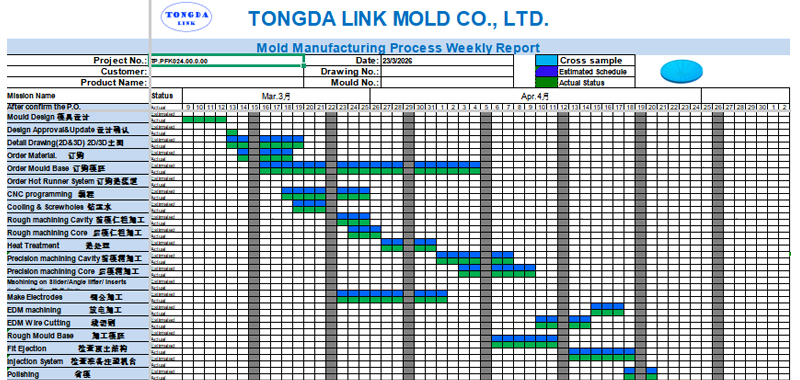
- Can they provide a detailed project timeline with milestones?
- Do they share progress photos and videos at key stages?
- How do they handle design changes and revision tracking?
Note on smaller suppliers: A 50-person precision mold shop often provides a more direct and responsive communication experience than a large factory. You are more likely to interact directly with the engineer working on your project, the owner, or a senior technical manager—rather than being routed through layers of sales representatives and coordinators. This direct access to technical decision-makers can significantly reduce miscommunication and accelerate problem resolution.
Phase 5: Commercial Terms and Pricing
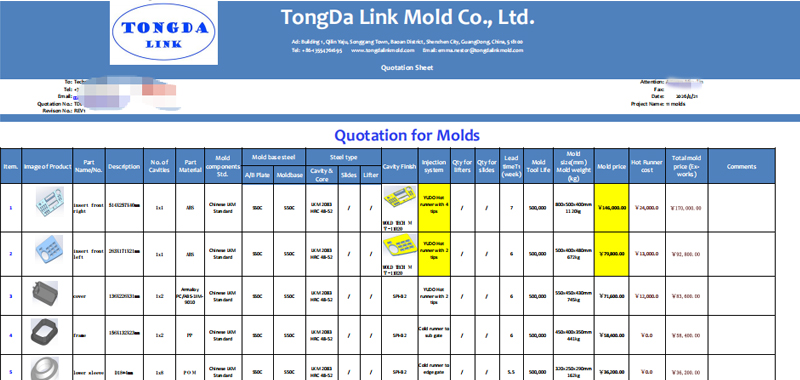
Quotation Breakdown
A professional quotation should include:
- Mold base: Size, material, standard components (Hasco, DME, LKM)
- Cavity and core steel: Grade, hardness, source (imported vs. domestic)
- Number of cavities: And expected cycle time
- Mold life guarantee: Number of shots guaranteed
- Hot runner system: Brand (Yudo, Synventive, HRS, Mastip) and type (valve gate, hot tip)
- Surface treatment: Texturing, polishing, coating (if applicable)
- Trial molds: How many T1/T2 trials are included?
- Delivery terms: FOB, CIF, EXW—and to which port
- Payment terms: Typical structure is 30-40% deposit, 30-40% after T1 approval, 20-30% before shipment
Price Benchmarking
- Get quotes from at least 3 suppliers for comparison.
- Be wary of prices that are significantly lower than the market average—this often indicates corner-cutting on steel quality, components, or quality control.
- Understand what is included and what is extra (e.g., mold texturing, hot runner, trial molds, shipping).
Intellectual Property Protection
- NDA (Non-Disclosure Agreement): Sign before sharing any design files.
- NNN Agreement (Non-Use, Non-Disclosure, Non-Circumvention): Stronger than a standard NDA in China. Prevents the supplier from using your design for other clients, disclosing it to third parties, or circumventing you with your customers.
Phase 6: Risk Management and Long-Term Partnership
Starting Small to Build Trust
For buyers evaluating a new supplier—particularly one without ISO certification—we recommend a phased approach:
- Phase 1 — Document review: Request the supplier’s Quality Assurance Package (quality manual, equipment list, sample CMM reports, trial videos). This costs nothing and takes 1-2 days.
- Phase 2 — Small test project: Commission a simple single-cavity mold or a non-critical component. This lets you evaluate quality, communication, and delivery with minimal financial risk.
- Phase 3 — Full project: Once satisfied with the test project, proceed with your production mold.
- Phase 4 — Long-term partnership: After 2-3 successful projects, establish a framework agreement with agreed pricing, quality standards, and lead times.
Factory Audit Options
- Remote video audit: Request a live video call (Zoom, WhatsApp) where the supplier walks you through their facility in real time. You can ask to see specific equipment, inspection processes, and ongoing projects.
- On-site audit: For larger projects, consider visiting the factory in person. A reputable supplier should welcome this and assist with logistics.
- Third-party inspection: Engage a third-party inspection company (e.g., SGS, Bureau Veritas, QIMA) to conduct a factory audit on your behalf. This typically costs $500-$1,500 and provides an independent assessment.
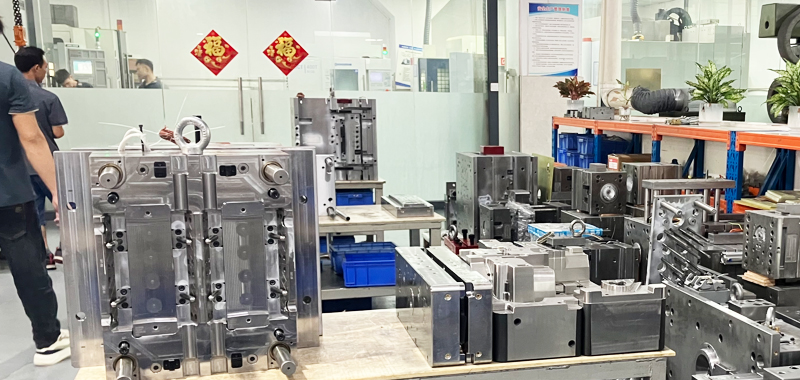
Schedule a Remote or On-Site Factory Tour
See our production floor, inspection lab, and molding machines in real time. We offer live video walkthroughs via Zoom or WhatsApp — or welcome you to visit our facility in person.
Evaluating Precision Capability Without Certifications
When a supplier does not hold ISO or industry-specific certifications, evaluate their precision capability through these concrete indicators:
| Indicator | What to Ask For | What It Proves |
|---|---|---|
| CMM Reports | Sample dimensional reports from CROMA or equivalent high-precision CMM | They can measure and document precision to micron-level accuracy |
| CNC Equipment | Specific brands (e.g., Mikron, Makino) with accuracy specs | They own precision hardware capable of ±0.005mm machining |
| EDM Capability | Machine brands, adaptive control features, surface finish specs | They achieve mirror-finish cavities without outsourcing |
| Trial Videos | Videos of mold trials showing part ejection (including 2K cycles if applicable) | Their molds function correctly in production |
| 2K Machine Ownership | In-house two-color injection molding machines (e.g., Haitian IAⅡ series) | They can validate 2K molds completely before delivery |
| Process Photos | In-process inspection at multiple stages | They check quality throughout, not just at the end |
| Technical Responses | Answers to specific material and process questions | Their team has genuine engineering expertise |
A supplier who can provide all of these has demonstrated capability—even without a certificate on the wall.
Real-World Case: When a Supplier Becomes a Problem-Solver
One of the strongest indicators of a mold supplier’s true capability is not what they say about themselves—it is what their existing customers ask them to do.
We recently worked with a client who had commissioned a multi-component mold from another supplier. The molded parts suffered from multiple quality issues that the original supplier was unable to resolve despite repeated rework attempts:
- Severe flash measuring up to 0.15mm on multiple parting lines, requiring extensive manual deflashing and still failing to meet cosmetic standards
- Persistent part warpage on several components that could not be corrected through process parameter adjustments alone
- Highly visible parting lines on transparent cover components, making the product look low-end and unacceptable for retail packaging
- Assembly gaps as wide as 1mm between mating components, causing misalignment and an appearance that did not reflect the premium positioning of the brand
These issues stalled the client’s product launch for months. Each round of rework by the original supplier addressed one symptom while introducing new problems elsewhere. The client faced a difficult choice: scrap the mold entirely and start over—at significant cost and further delay—or find a partner who could diagnose the root causes and deliver a working solution.
The client chose to ship the mold to our facility. Our engineering team conducted a systematic root-cause analysis, identifying that the core issues stemmed from inadequate mold steel precision, poor parting surface machining, and insufficient cooling channel design that caused uneven shrinkage and warpage.
Over a two-month repair period, we performed comprehensive rework—some mold structures were entirely rebuilt from scratch. Key interventions included:
- Re-machining critical parting surfaces on our Mikron CNC to ±0.005mm accuracy, reducing flash from 0.15mm to 0.02mm—effectively eliminating the need for any manual deflashing
- Optimizing parting line geometry and clamp tonnage distribution to eliminate the root cause of flash, rather than repeatedly treating the symptom
- Redesigning and re-machining core structural components where the original geometry could not be salvaged
- Optimizing the parting line on transparent cover components using precision EDM, reducing witness marks to a clean, natural aesthetic line
- Adjusting the cooling layout to achieve uniform wall cooling and eliminate warpage
The results after repair and validation:
| Quality Metric | Before Repair | After Repair |
|---|---|---|
| Flash at parting line | 0.15mm | 0.02mm |
| Assembly gap (max) | 1.0mm | 0mm — clean natural parting line |
| Transparent cover parting line | Highly visible, rough | Clean, natural aesthetic line |
| Part warpage | Unresolvable | Within specification |
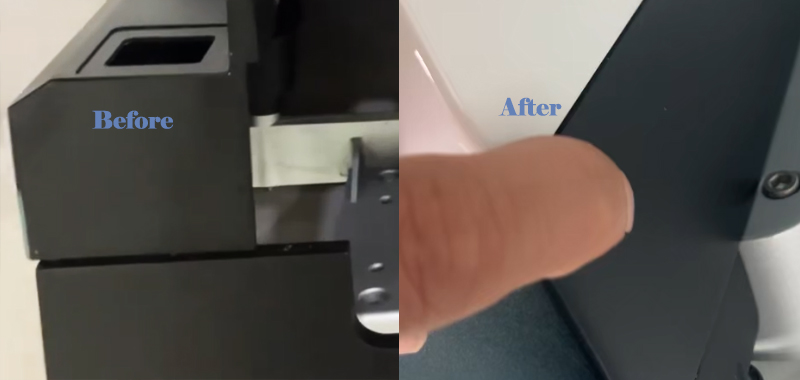
Once the mold met specification, we also took on the injection molding production on our in-house Haitian two-color injection molding machines—providing a complete solution from mold repair to mass production under one roof.
This case illustrates several points that buyers should consider when evaluating suppliers:
- Can the supplier diagnose root causes, not just symptoms? The original supplier kept treating individual defects. Our team identified that multiple seemingly unrelated issues all traced back to fundamental machining precision and cooling design deficiencies.
- Can they fix problems, not just build new molds? A supplier who can rescue a failing mold—rebuilding structures where necessary—demonstrates deeper engineering understanding than one who only builds from scratch.
- Do existing customers trust them with critical situations? When a client is willing to ship a failed mold from another supplier—essentially betting their product launch timeline on your team’s ability to rescue it—that is the strongest form of reference.
- Can they provide end-to-end service? Mold repair plus injection molding production under one roof eliminates the finger-pointing that occurs when the mold maker and the molder are different companies.
When evaluating a potential supplier, ask directly: “Can you share an example of a time you resolved a problem that another supplier could not?” A confident, specific answer—backed by measurable results—is worth more than any certification on the wall.
Have a Mold That Needs Rescue?
If you’re dealing with flash, warpage, poor surface finish, or assembly fit issues from a mold built by another supplier, send us the part drawings and photos. Our engineering team will provide a free root-cause analysis and repair feasibility assessment — no commitment required.
Conclusion
Evaluating a plastic mold supplier in China requires a systematic approach that goes beyond price comparison. By following this checklist—verifying company background, auditing technical capability, assessing quality systems, testing communication, reviewing commercial terms, and managing risk—you can make a confident sourcing decision.
Remember: certifications are one indicator of quality, but they are not the only one. A supplier’s willingness to provide transparent documentation, accept small test projects, welcome factory audits, and demonstrate technical expertise through real project evidence is often a more reliable indicator of their true capability.
Contact Us For a Free Quote
Why Is TONGDA LINK Mold High-Quality?
The right partner is not necessarily the biggest or the most certified—it is the one whose equipment capabilities (precision CNC, high-accuracy CMM, in-house molding machines), communication style, and quality commitment align with your specific project requirements. A 50-person precision mold shop equipped with Mikron CNC centers, Makino EDM machines, CROMA CMMs, and Haitian two-color injection molding machines can deliver results that rival or exceed much larger factories—because precision is determined by equipment quality and engineering expertise, not headcount.
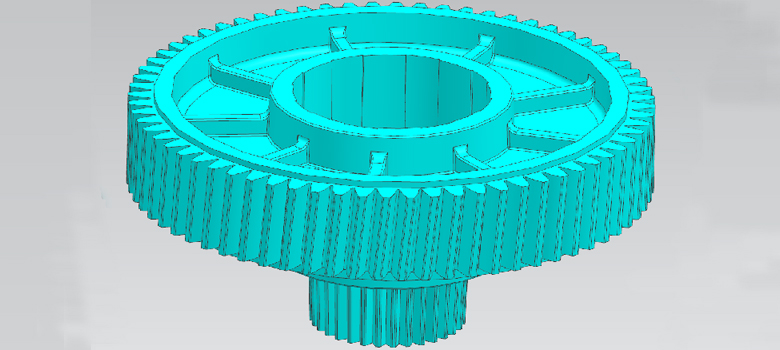
Case Study: Plastic Gear Mold Manufacturing
Ready to Start Your Next Mold Project?
Send us your 3D drawings or product samples. We’ll provide a detailed quotation within 48 hours — including mold design, material recommendations, tooling timeline, and injection molding production plan.
