
How to Choose the Right Mold Steel for Automotive Interior Parts (1.2083 vs 1.2316 vs M340 vs 718H vs 1.2344 vs POLMAX vs AMPCOLOY 940)
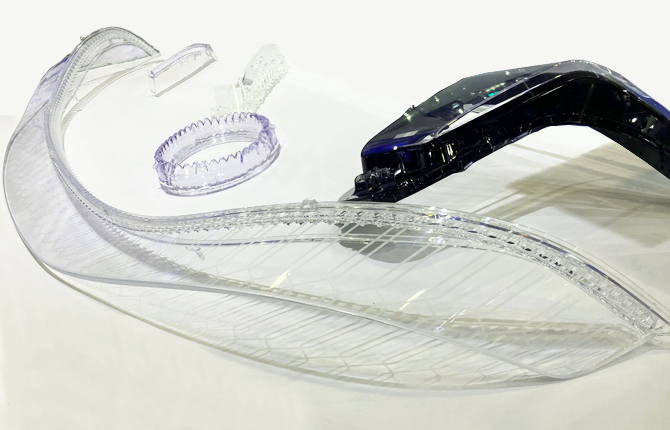
Why Mold Steel Selection Matters for Automotive Interiors
Automotive interior tooling operates under some of the most demanding conditions in the plastics industry. Unlike consumer electronics or packaging, interior components must survive extreme manufacturing environments while meeting stringent aesthetic and functional standards.
Four critical factors dictate steel selection:
1. Mass Production Stability:
2. Surface Quality Standards:
3. Chemical Exposure:
4. Thermal Cycling:
420 Stainless Mold Steels: The Corrosion-Resistant Family (1.2083/S136, 1.2316, 1.2312)
The 420 family of martensitic stainless mold steels is the most widely used group for automotive interior molds requiring high polishability and corrosion resistance. While these steels share a common chromium content (13-16% Cr), they differ significantly in carbon content, corrosion resistance, and suitability for application.
1.2083 / S136 — The Standard Corrosion-Resistant Polisher
.2083 (DIN) and S136 (Assab/SSAB brand name) belong to the same 420 martensitic stainless steel category with very similar composition and performance. They are among the most interchangeable grades in the 420 family, and in many workshops, the two designations are selected based on brand availability and regional supply preference.
Key Properties:
- Chromium: ~13%
- Hardness after heat treatment: HRC 48-52
- Polishability: Up to SPI A1 (Ra 0.025μm)
- Corrosion resistance: Excellent for standard corrosive resins
Strengths:
- Superior corrosion resistance: The 13%+ chromium content makes 1.2083/S136 the go-to choice when molding corrosive materials such as PVC, flame-retardant ABS, glass-fiber-reinforced engineering plastics, or any resin that releases acidic byproducts during processing.
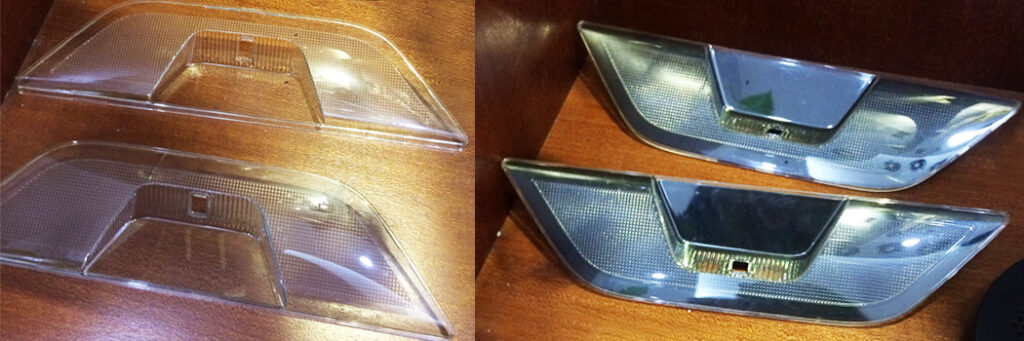
- Outstanding polishability: 1.2083/S136 can achieve mirror finishes up to SPI A1 grade (approximately Ra 0.025μm). Its fine, uniform grain structure and low inclusion content allow for consistent, defect-free polishing—critical for high-gloss automotive interior trim, ambient lighting lenses, and chrome-plated substrates.
- Long-term surface stability: Unlike carbon steels, 1.2083/S136 does not develop rust stains or corrosion pits during storage or production downtime, preserving the mold’s surface quality over years of use.
Limitations:
- Lower toughness: At HRC 48-52, 1.2083/S136 is relatively brittle compared to 1.2344. It is more susceptible to chipping at sharp corners, thin ribs, and deep cavity features where stress concentration is high.
- Higher cost: 1.2083/S136 is significantly more expensive than 718H, typically costing 2-3x more per kilogram.
- Heat treatment required: Unlike pre-hardened steels, 1.2083/S136 is supplied in annealed condition (HB 160-200) and requires vacuum quenching and tempering after rough machining, adding time and cost to mold manufacturing.
Best For:
- High-gloss dashboard trim and decorative panels
- Ambient lighting housings and light guide components
- Chrome-plated substrate molds (where surface pitting would ruin plating quality)
- Molds using PVC — 1.2083/S136 resists HCl attack far better than 1.2344, which has only 5% chromium
- Molds using POM (acetal) — 1.2083/S136 resists formaldehyde corrosion, extending mold life to 500K+ cycles vs. premature failure with 1.2344
- Molds using moderately corrosive resins (flame-retardant ABS, high-glass-fill materials with non-aggressive matrices)
- Optical-grade interior lenses and transparent components (for non-critical optical surfaces)
Unsure Which Steel is Right for Your Application?
Our team at TONGDA LINK MOLD can review your part design, resin specification, and production requirements to provide a confident material recommendation backed by a decade of automotive interior mold manufacturing.
1.2316 — The Heavy-Duty Corrosion Fighter
.2316 is a sulfur-alloyed martensitic stainless steel with higher chromium content and optimized corrosion resistance specifically designed for the most aggressive molding environments.
Key Properties:
- Chromium: ~15-16%
- Hardness after heat treatment: HRC 48-52
- Polishability: Up to SPI A1-A2
- Corrosion resistance: Superior to 1.2083/S136 — specifically engineered for halogen-containing and highly acidic resins
Best For:
- Molds running PVC, POM, or halogenated flame-retardant grades
- Medical component molds requiring frequent sterilization cleaning
- Long-run production molds (>1M cycles) with corrosive engineering plastics where 1.2083/S136 would show premature surface degradation
1.2312 — The Pre-Hardened 420 Option
.2312 is a sulfur-improved, pre-hardened variant in the 420 stainless category. It offers good machinability and moderate corrosion resistance, making it a practical choice when lead time is critical and the molding environment is less aggressive.
Key Properties:
- Supplied pre-hardened: HRC 38-42
- Polishability: Up to SPI A2-A3
- Corrosion resistance: Moderate — suitable for non-corrosive to mildly corrosive resins
Best For:
- Large interior molds where pre-hardened delivery saves 2-3 weeks of lead time
- Textured or semi-gloss surfaces where SPI A1 mirror finish is not required
- Applications where moderate corrosion resistance is sufficient
POLMAX — The Optical-Grade Mirror Steel
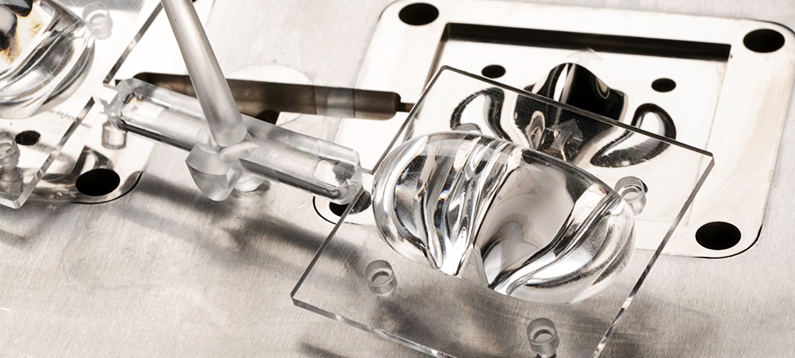
When mold requirements exceed what standard 420 stainless steels can deliver — particularly for optical lenses, transparent components, and ultra-high-gloss surfaces — POLMAX becomes the material of choice.
POLMAX is an ultra-pure martensitic stainless mold steel produced by Uddeholm (ASSAB) using a dual-melt process: Electroslag Remelting (ESR) followed by Vacuum Arc Remelting (VAR). This two-stage refining dramatically reduces inclusions and segregation, producing a steel with exceptional purity and uniformity.
Key Properties:
- Chemical composition: C 0.38%, Cr 13.6%, Si 0.9%, Mn 0.5%, V 0.3%
- Hardness after heat treatment: HRC 48-52
- Polishability: Optical-grade mirror finish — superior to standard S136/1.2083
- Corrosion resistance: Excellent (13.6% Cr)
- Heat treatment dimensional stability: Excellent — minimal distortion during hardening
Why POLMAX over S136/1.2083 for optical applications?
Standard S136/1.2083 can achieve SPI A1 mirror finishes, but for optical-grade surfaces where even microscopic inclusions cause visible defects in the molded lens or transparent part, POLMAX’s dual-melt purity makes the difference. The ESR+VAR process eliminates the non-metallic inclusions and carbide banding that would otherwise create subtle surface defects under critical lighting conditions.
Typical Applications:
- Optical lenses (automotive lighting lenses, sensor covers)
- Transparent interior components (light guides, ambient lighting housings)
- CD/DVD/Blu-ray disc molds
- Medical optical components
- Any application requiring flawless mirror surfaces where standard S136 shows micro-defects under inspection
M340 — The Super Corrosion-Resistant Specialty Mold Steel
Key Properties
Three Core Advantages
Typical Applications
When to Choose M340 Over Standard 420 Steels
M340 is the right choice when your application demands the combination of:
718H / 1.2738 (Pre-Hardened Mold Steel): The Production Economy Workhorse
718H (also designated as 1.2738 per DIN/EN standards) is a nickel-chromium-molybdenum alloy steel, supplied pre-hardened to HRC 33-38 (approximately 320-360 HB). The “H” designation indicates that it has been hardened and tempered at the mill, eliminating the need for post-machining heat treatment.
Strengths:
- Excellent machinability: Because 718H is pre-hardened, it can be machined directly without the distortion risks associated with post-hardening. This reduces mold manufacturing lead time by 2-3 weeks compared to through-hardening steels.
- Good balance of hardness and toughness: At HRC 33-38, 718H offers sufficient wear resistance for medium-to-high volume production while maintaining enough toughness to resist cracking in complex cavity geometries with deep ribs and sharp corners.
- Uniform hardness throughout: Pre-hardened 718H exhibits hardness deviation of ≤5% across large mold inserts, ensuring consistent machining behavior and polishing results across the entire cavity.
- Cost-effective: 718H is significantly less expensive than 1.2083/S136, making it the economical choice for large automotive interior molds where corrosion resistance is not a primary concern.
- Good polishability: While not matching 1.2083/S136’s mirror finish capability, 718H can achieve SPI A2-A3 grade finishes (Ra 0.05-0.1μm), which is sufficient for most textured and semi-gloss interior surfaces.
Limitations:
- Moderate corrosion resistance: 718H has some chromium content but far less than 1.2083/S136. It can handle standard engineering plastics but will develop surface degradation when exposed to highly corrosive resins over extended production runs.
- Lower maximum hardness: At HRC 33-38, 718H is not suitable for applications requiring extreme wear resistance or high-temperature operation.
- Not ideal for mirror finishes: For Class A high-gloss surfaces requiring SPI A1 grade, 718H may show subtle polishing inconsistencies that 1.2083/S136 would not.
Ideal Applications for Automotive Interiors:
- Instrument panel substrates and door panel molds
- Center console housings and storage compartment molds
- HVAC duct and vent components
- Seat trim and headrest structural molds
- Any interior mold where the resin is non-corrosive (PP, ABS, PC/ABS, TPO) and the surface finish is textured or semi-gloss
1.2344 / 1.2343 (H13 Hot-Work Die Steels): The Thermal Fatigue Specialists
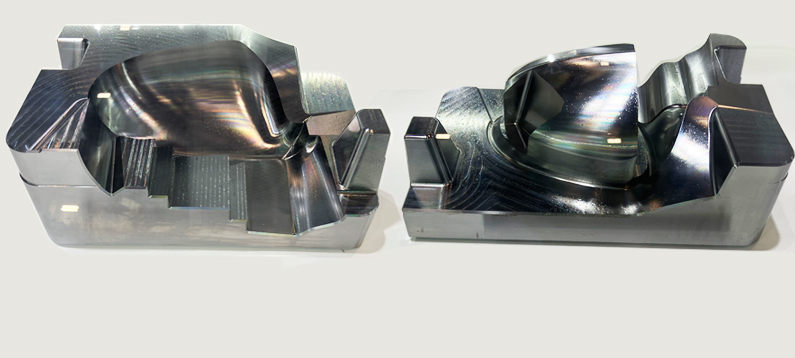
The 1.2344 and 1.2343 hot-work tool steels (commonly known by their AISI designation H13) are chromium-molybdenum-vanadium alloy steels designed specifically for applications involving repeated thermal cycling. Both achieve a hardness of HRC 45-52 after vacuum quenching and double tempering, with exceptional toughness and thermal fatigue resistance.
While 1.2344 and 1.2343 share the same fundamental alloy system, 1.2343 features an optimized alloy composition that delivers improved toughness and enhanced resistance to thermal fatigue cracking. This makes 1.2343 the preferred choice for the most demanding thermal cycling applications, while 1.2344 remains the standard workhorse for general hot-work applications.
Strengths (shared by both grades):
- Exceptional thermal fatigue resistance: Outstanding resistance to heat checking—those fine surface cracks that develop from repeated heating and cooling cycles. This makes them ideal for molds operating at elevated temperatures.
- High-temperature strength: Maintains hardness and structural integrity at mold temperatures up to 200°C and beyond, where other steels would soften and deform.
- Superior toughness: Best toughness-to-hardness ratio among common mold steels, resistant to cracking in complex geometries with thin walls, deep cavities, and sharp internal corners.
- Good wear resistance: After proper heat treatment and optional surface treatments (nitriding, PVD coating), delivers excellent wear resistance for high-volume production.
When to choose 1.2343 over 1.2344:
- Molds with extreme thermal cycling (>1M cycles at high mold temps)
- Complex geometries with thin walls and sharp internal corners where maximum toughness is critical
- High-performance automotive lighting molds (LED, laser light sources)
- Any application where thermal fatigue cracking has been a recurring problem with 1.2344
Limitations:
- Poor corrosion resistance: Only ~5% chromium — far below the 13% threshold for true stainless performance. Will rust and corrode when exposed to moisture or corrosive plastics unless protected by surface coatings.
- Lower polishability: Carbide structure makes it difficult to achieve mirror finishes. Generally limited to SPI A3 or coarser finishes.
- Heat treatment required: Adds lead time and cost.
- Not suitable for high-gloss surfaces: Best used for non-visible or textured interior components where surface finish is secondary to structural performance.
Ideal Applications:
- Molds for glass-fiber-reinforced engineering plastics (PA66+GF, PPA+GF, PBT+GF) — the high hardness and toughness resist glass fiber abrasion on cavity surfaces, thin ribs, and sharp corners
- Molds operating at elevated mold temperatures (>120°C)
- LED lamp housing molds and high-thermal-cycling applications
- Interior structural components with complex deep-cavity geometries
- Under-hood adjacent interior components (near engine bay heat sources)
- Molds for high-temperature engineering plastics (PEEK, PPS, high-temp nylon)
High-Thermal-Conductivity Alloys: Beryllium Copper and AMPCOLOY 940
Not all mold components are made from steel. For mold inserts and cores that require rapid heat dissipation — where cooling channel placement is limited or where cycle time reduction is critical — high-thermal-conductivity copper alloys are essential.
Why Copper Alloys in a Steel Mold?
In complex mold geometries, certain core areas are too small or too deep to accommodate conventional cooling channels. These “hot spots” retain heat, causing longer cycle times, sink marks, warpage, and dimensional instability. Inserting a high-conductivity copper alloy core or pin in these areas accelerates heat transfer to the surrounding cooling system, reducing cycle times by 20-60% and improving part quality.
Beryllium Copper (BeCu) — The Traditional Choice
Beryllium copper alloys (containing 0.5-2.0% beryllium) have long been the standard for high-conductivity mold inserts. They offer:
- Thermal conductivity: 105-120 W/m·K (3-4x higher than tool steel)
- Hardness: HRC 26-42 depending on grade
- Good wear resistance and mechanical strength
However, beryllium is a highly toxic element. Beryllium dust and fumes generated during machining, grinding, and EDM operations pose serious health risks — chronic beryllium disease is a life-threatening lung condition. For this reason, European and North American regulations increasingly restrict the use of beryllium-containing materials in manufacturing facilities.
AMPCOLOY 940 — The Beryllium-Free Replacement
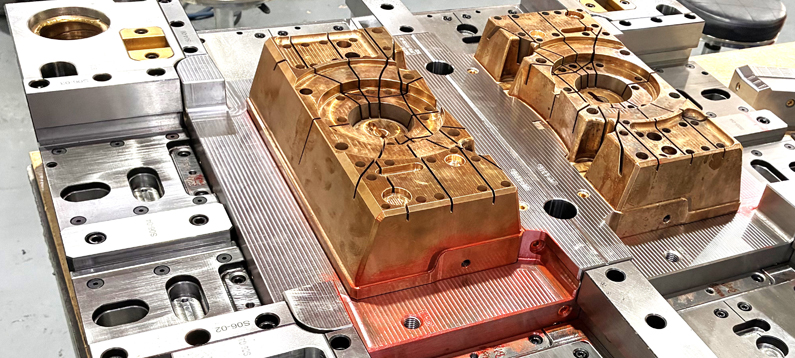
AMPCOLOY 940, developed by AMPCO METAL, is a patented copper-nickel-silicon-chromium alloy specifically designed to replace beryllium copper in all mold applications. It delivers comparable or superior performance without any toxicity concerns.
Key Properties:
- Composition: Ni 2.5%, Si 0.7%, Cr ≤0.4%, Cu balance
- Hardness: 210 HB (95 HRB)
- Thermal conductivity: 208 W/m·K — nearly double that of beryllium copper, and 5-6x higher than P20 tool steel
- Tensile strength: 689 MPa
- Beryllium-free: Fully compliant with EU and North American health and safety regulations
AMPCOLOY 940 vs. Beryllium Copper:
|
Property |
BeCu (0.5% Be) |
AMPCOLOY 940 |
|
Thermal Conductivity |
105-120 W/m·K |
208 W/m·K |
|
Hardness |
HRC 26-38 |
210 HB (95 HRB) |
|
Beryllium Content |
Toxic(Health Hazard) |
Beryllium-free, safe |
|
Machinability |
Good |
Good |
|
EDM Machinability |
Good |
Poor — avoid EDM operations |
|
Regulatory Compliance |
Restricted in EU/US |
Fully compliant |
-Important Manufacturing Note: AMPCOLOY 940 has very poor EDM (electrical discharge machining) performance. When designing AMPCOLOY 940 inserts, prioritize CNC machining and avoid EDM operations wherever possible.
Typical Applications:
- Core pins and inserts in hot-spot areas where cooling channels cannot reach
- Injection mold cooling inserts for thick-walled sections
- Automotive headlight mold cores (where rapid cooling is critical for optical clarity)
- Any mold component where cycle time reduction justifies the material cost premium
Need help selecting the right mold steel? TONGDA LINK MOLD has over 10 years of experience manufacturing precision molds for European and American Tier 2 suppliers. Our engineering team can evaluate your resin, part geometry, and production volume to recommend the optimal steel grade for your automotive interior application.
Contact Us For a Free Material Consultation
Comprehensive Mold Steel Comparison Table
Selecting the correct mold steel requires balancing multiple mechanical and chemical properties. The following table compares eight industry-standard materials across eleven critical performance metrics for automotive interior tooling.
|
Property |
1.2083/S136 |
POLMAX |
1.2316 |
1.2312 |
718H/1.2738 |
1.2344 |
1.2343 |
AMPCOLOY 940 |
|
Type |
420 SS |
420 SS (ESR+VAR) |
420 SS |
420 SS (pre-hard) |
Pre-hardened |
Hot-work |
Hot-work |
Cu alloy |
|
Hardness |
HRC 48-52 |
HRC 48-52 |
HRC 48-52 |
HRC 38-42 |
HRC 33-38 |
HRC 45-52 |
HRC 45-52 |
210 HB |
|
Corrosion Res. |
★★★★ |
★★★★★ |
★★★★★ |
★★★ |
★★★ |
★★ |
★★ |
★★★ |
|
Polishability |
★★★★★ (A1) |
★★★★★+ (Optical) |
★★★★★ (A1-A2) |
★★★★ (A2-A3) |
★★★★ (A2-A3) |
★★★ (A3) |
★★★ (A3) |
N/A |
|
Toughness |
★★★ |
★★★ |
★★★ |
★★★ |
★★★★ |
★★★★★ |
★★★★★+ |
★★★ |
|
Thermal Fatigue |
★★★ |
★★★ |
★★★ |
★★★ |
★★★ |
★★★★★ |
★★★★★+ |
N/A |
|
Thermal Conductivity |
~25 W/m·K |
~25 W/m·K |
~25 W/m·K |
~30 W/m·K |
~30 W/m·K |
~28 W/m·K |
~28 W/m·K |
208 W/m·K |
|
Machinability |
★★★ |
★★★ |
★★★ |
★★★★ |
★★★★★ |
★★★★ |
★★★★ |
★★★★ |
|
Cost (Relative) |
Medium-High |
Very High |
High |
Medium |
Low |
Medium-High |
Medium-High |
High |
|
Heat Treatment |
Yes |
Yes |
Yes |
No |
No |
Yes |
Yes |
No |
|
Typical Mold Life |
500K-1M+ |
500K-1M+ |
500K-1M+ |
300K-500K |
300K-500K |
500K-1M+ |
500K-1M+ |
N/A (insert) |
Resin-to-Steel Quick Reference Table
Automotive interior parts utilize a wide range of engineering resins, each presenting unique chemical and thermal challenges during injection molding. Use this quick reference matrix to match your resin system to the most appropriate mold steel.
|
Resin |
Recommended Mold Material |
Why |
Avoid |
|
PVC |
M340, 1.2083/S136, 1.2316 |
HCl corrosion resistance (13%+ Cr; M340 with 17.25% Cr for extreme cases) |
1.2344 (only 5% Cr) |
|
POM (Acetal) |
1.2083/S136 |
Formaldehyde corrosion resistance |
1.2344 (surface pitting) |
|
PA66 + GF |
1.2344, 1.2343, M340 |
Toughness + wear resistance vs. glass fiber; M340 (HRC 53-58) for corrosion + wear combo |
1.2083 (chipping at ribs) |
|
Flame-retardant (halogenated) |
1.2316 |
Highest corrosion resistance in 420 family |
1.2344, 718H |
|
PP, ABS, PC/ABS, TPO |
718H/1.2738 |
Cost-effective for non-corrosive resins |
Over-specifying stainless |
|
High-temp engineering (PEEK, PPS) |
1.2343 |
Best thermal fatigue resistance |
718H (softens at high temp) |
|
Optical lenses, transparent parts |
POLMAX, M340 S136/1.2083 |
Optical-grade mirror finish, high purity; M340 for corrosive optical resins |
1.2344, 718H (inclusions) |
|
Thick-wall parts (cycle time critical) |
AMPCOLOY 940 inserts |
208 W/m·K thermal conductivity, beryllium-free |
Standard steel cores (slow cooling) |
Real-World Lessons: When Steel Selection Goes Wrong
Theoretical material data sheets tell only part of the story. At TONGDA LINK MOLD, we have manufactured hundreds of automotive interior molds for European and American Tier 2 suppliers, and we have seen firsthand how incorrect steel selection leads to costly failures. All of which could have been avoided with the correct steel selection from the start. The following five case studies are drawn directly from our production experience.
Case 1: PVC Interior Trim — 1.2344 vs. 1.2083/S136
A customer requested a mold for PVC interior trim components and specified 1.2344 (H13) based on its reputation for toughness. The mold was built, heat-treated, and put into production.
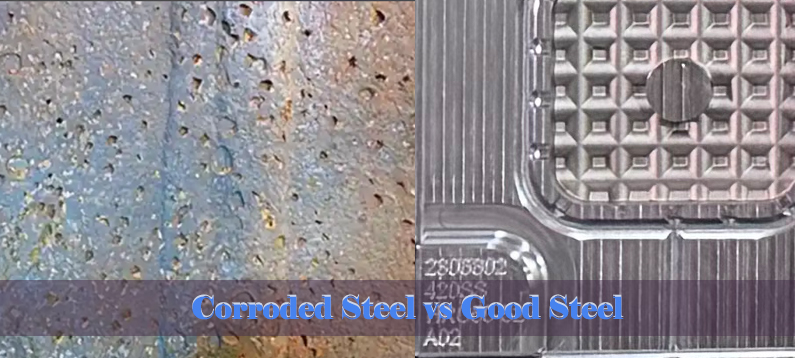
Within 15,000 shots, the cavity surface showed visible corrosion pitting. By 30,000 shots, the pitting had deepened enough to cause cosmetic defects on every molded part. The mold had to be pulled from production, re-machined, and re-polished — at a cost that exceeded the original price difference between 1.2344 and 1.2083/S136.
The root cause: PVC releases hydrochloric acid (HCl) during processing. 1.2344 contains only 5% chromium — far below the threshold needed to resist HCl attack. A 420 stainless steel like 1.2083/S136, with 13%+ chromium, would have resisted this corrosion for 500,000+ cycles without issue.
Lesson: For PVC and other halogen-containing resins, the 420 stainless family is not optional — it is mandatory. There is another mold steel M340 which cost higher is better for PVC product manufacturing.
Case 2: POM Interior Components — 1.2344 vs. 1.2083/S136
Another customer produced POM (acetal) interior components using a mold built in 1.2344. POM releases formaldehyde gas during injection, which chemically attacks non-stainless mold steels.
The mold showed surface degradation after approximately 40,000 shots — well below the expected 500,000-shot mold life. The customer assumed the steel was “defective” and requested a replacement.
In reality, the steel was perfectly fine — it was simply the wrong choice for POM. Switching to 1.2083/S136 extended the mold life to over 600,000 cycles with no surface degradation.
Lesson: POM is deceptively corrosive. Its formaldehyde byproduct attacks 1.2344 aggressively. 1.2083/S136 is the correct choice for significantly longer mold life.
Case 3: PA66 + 30% GF — 1.2083 vs. 1.2344
A customer building a mold for glass-fiber-reinforced nylon (PA66 + 30% GF) specified 1.2083/S136 because they wanted “the best steel available.” The mold produced excellent parts for the first 20,000 shots. Then thin ribs began chipping, and sharp corners started rounding.
The glass fibers in PA66+GF act like sandpaper on the mold surface. While 1.2083/S136 offers excellent corrosion resistance, it lacks the toughness needed to withstand glass fiber abrasion in thin, high-stress features.
The correct choice was 1.2344 — its superior toughness and wear resistance at HRC 48-52 handle glass fiber abrasion effectively, delivering consistent part quality for 500,000+ cycles.
Lesson: “Best steel” does not exist. The right steel depends on the specific demands of the application.
Case 4: Optical Lens — S136 vs. POLMAX
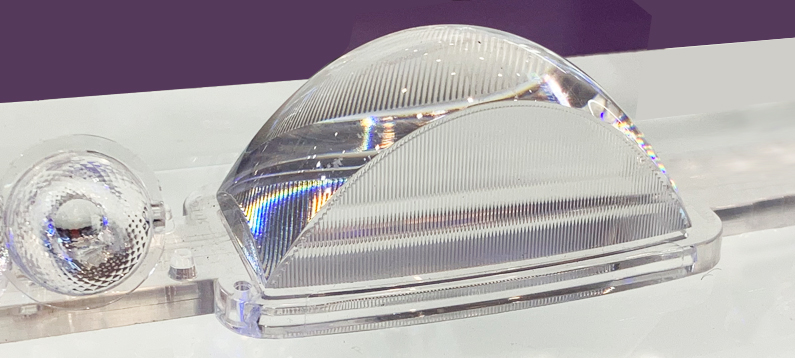
A customer producing automotive ambient lighting lenses specified standard S136/1.2083 for the lens cavity. The first 5,000 shots produced acceptable parts. But under controlled lighting inspection, microscopic inclusions in the steel created subtle surface defects on the lens — visible as light-scattering anomalies in the finished product.
Switching to POLMAX (ESR+VAR dual-melt) eliminated these defects. The ultra-high purity of POLMAX produced optically flawless lens surfaces that passed the customer’s stringent light transmission and clarity tests.
Lesson: For optical-grade transparent components, standard S136 is often insufficient. POLMAX’s dual-melt purity is the difference between “good enough” and “optically perfect.”
Case 5: Thick-Wall Housing — Steel Core vs. AMPCOLOY 940 Insert
A customer molding a thick-walled automotive housing experienced cycle times of 45 seconds — far longer than expected. The thick sections in the core area had no direct cooling channel access, creating a heat trap that forced the customer to wait for adequate cooling before ejection.
By replacing the standard 1.2344 core pin with an AMPCOLOY 940 insert (thermal conductivity: 208 W/m·K vs. 28 W/m·K for steel), the cycle time dropped to 28 seconds — a 38% reduction. The AMPCOLOY 940 rapidly conducted heat from the thick section to the surrounding cooling channels, accelerating solidification.
The customer also specifically requested AMPCOLOY 940 over beryllium copper to comply with their European facility’s health and safety requirements.
Lesson: For thick sections and hot spots, a high-conductivity copper alloy insert can dramatically reduce cycle time. And with beryllium copper increasingly restricted, AMPCOLOY 940 is the safe, high-performance alternative.
Let TONGDA LINK MOLD Bring This Expertise to Your Mold Project.
Our team has navigated these exact challenges for European and American clients and can help you avoid costly material missteps.
The Common Thread
In every case above, the customer selected a steel that was either more expensive or more well-known — but not the correct one for their specific resin and application.
The result was always the same:
- Premature surface degradation
- Rejected parts and production downtime
- Emergency mold repairs costing more than the steel price difference
- Damaged reputation with their end customer
Choosing the correct steel for the application will always outperform choosing the most expensive steel. Understanding the resin chemistry, production volume, surface finish requirements, and geometric complexity — and matching them to the right steel grade — is the foundation of every successful mold project.
Decision Framework: How to Choose the Right Mold Steel
Use this step-by-step logic to select the right steel for your automotive interior mold:
Step 1: Identify the resin chemistry — this is the single most important factor.
→ PVC (polyvinyl chloride):
PVC releases hydrochloric acid (HCl) during processing. This is one of the most corrosive environments a mold can face.
✓ Correct choice: 420 stainless family (1.2083/S136 or 1.2316)
✗ Wrong choice: 1.2344/1.2343 — only 5% chromium, will corrode rapidly, mold surface degrades within weeks
→ POM (polyoxymethylene/acetal):
POM releases formaldehyde during processing, which attacks non-stainless steels aggressively.
✓ Correct choice: 1.2083/S136 — superior corrosion resistance extends mold life significantly
✗ Wrong choice: 1.2344 — will show surface pitting and corrosion much earlier than expected
→ PA66 + Glass Fiber (glass-fiber-reinforced nylon):
The glass fibers create extreme abrasive wear on the mold surface.
✓ Correct choice: 1.2344 or 1.2343 — high hardness (HRC 48-52) after heat treatment provides excellent wear resistance against glass fiber abrasion
✓ Alternative: M340 (HRC 53-58, 17.25% Cr) — when the application also involves corrosive resins, M340 provides both superior wear resistance and exceptional corrosion resistance in a single material
✗ Wrong choice: 1.2083/S136 — while corrosion-resistant, it lacks the toughness and wear resistance needed for high glass-fill materials; thin ribs and sharp corners will chip
→ Flame-retardant grades (halogenated):
✓ Correct choice: 1.2316 — highest corrosion resistance in the 420 family for the most aggressive chemical environments
→ Standard engineering plastics (PP, ABS, PC/ABS, TPO):
✓ Correct choice: 718H/1.2738 — most cost-effective for non-corrosive resins
Step 2: Is the surface finish requirement SPI A1 (mirror/high-gloss)?
→ Yes → 420 stainless family (1.2083/S136 or 1.2316)
→ No → Proceed to Step 3
Step 3: Is the mold operating at elevated temperatures (>120°C mold temp)?
→ Yes → 1.2343 for extreme thermal cycling, 1.2344 for standard
→ No → Proceed to Step 4
Step 4: Is the geometry complex with deep ribs, thin walls, or sharp corners?
→ Yes → 1.2343 (best toughness) or 718H/1.2738 (good toughness, no heat treatment needed)
→ No → Proceed to Step 5
Step 5: Is the production volume moderate (<500K cycles) with standard resins and textured finishes?
→ Yes → 718H/1.2738 (most cost-effective)
→ Need faster delivery? → 1.2312 (pre-hardened 420 option)
Step 6: Is the part an optical lens or transparent component requiring a flawless mirror finish?
→ Yes → POLMAX for critical optical surfaces (lenses, light guides)
→ High-gloss but non-optical → S136/1.2083 is sufficient
→ Corrosive optical resin (PVC, POM, halogenated) → M340 for combined corrosion resistance + polishability
Step 7: Are there mold areas with poor cooling access or thick sections requiring rapid heat dissipation?
→ Yes → Specify AMPCOLOY 940 inserts for hot-spot cores/pins
→ Beryllium copper (BeCu) is no longer recommended due to toxicity regulations in European and North American markets
Cost Considerations: Total Cost of Ownership
While 1.2083/S136 and POLMAX have the highest upfront material costs, they often deliver the lowest total cost of ownership for high-volume, high-surface-quality, or corrosive-resin applications.
Here is why:
Reduced maintenance: Corrosion-resistant steels eliminate the need for frequent mold cleaning, rust removal, and surface re-polishing during production runs.
Longer mold life: A well-maintained 1.2083/S136 mold can exceed 1,000,000 cycles without significant surface degradation, compared to 300,000-500,000 for 718H in corrosive environments. M340, with its 17.25% chromium and HRC 53-58 hardness, can extend mold life even further in extreme corrosion + wear applications.
Lower scrap rates: Consistent surface quality means fewer rejected parts due to cosmetic defects.
Cycle time savings: AMPCOLOY 940 inserts in hot-spot areas can reduce cycle times by 20-60%, delivering significant per-part cost savings over high-volume production runs.
The principle is simple: spend more on steel to save significantly more in production.
Conversely, specifying POLMAX for a simple, low-volume, non-corrosive application where 718H would suffice is an unnecessary expense. Always match the steel grade to the actual demands of the application.
There is no single “best” mold steel for automotive interior applications. The 420 stainless family (1.2083/S136, 1.2316, 1.2312, and POLMAX) excels in corrosion resistance and polishability. In contrast, M340 — a proprietary super corrosion-resistant specialty steel with 17.25% chromium and HRC 53-58 hardness — delivers an unmatched combination of corrosion resistance, wear resistance, and optical-grade polishability for the most demanding applications; pre-hardened steels (718H/1.2738) offer the best economy and machinability, hot-work steels (1.2344, 1.2343) deliver unmatched thermal fatigue resistance and wear performance. High-conductivity alloys (AMPCOLOY 940) solve cooling challenges that steel alone cannot address.
The optimal choice depends on a careful evaluation of resin chemistry, surface finish requirements, production volume, thermal conditions, and geometric complexity. By understanding the specific strengths of each steel grade — and the differences within each family — you can make informed decisions that balance performance, quality, and cost.
Remember: choosing the correct steel for the application matters far more than choosing the most expensive one. The right match is what delivers long mold life, consistent part quality, and the lowest total cost of ownership.
Need help selecting the right mold steel for your next automotive interior project?
At TONGDA LINK Mold, we specialize in precision injection molds for automotive interior applications — from material selection and DFM optimization to full mold manufacturing and trial production.
TONGDA LINK Engineering Team Can Guide You to the Right Solution
At TONGDA LINK MOLD, we specialize in precision injection molds for automotive interior applications. Based in Shenzhen, China, we have served European and American Tier 2 mold suppliers since 2016, building on over a decade of manufacturing expertise. Our 50-person team operates 8 CNC machines, 6 EDM machines, and 6 injection molding machines, delivering 360–400 mold sets annually. Our technical strengths include mirror polishing to SPI A1, large-format mold manufacturing, and multi-color mold systems—all critical capabilities for the demanding automotive interior sector. When you partner with TONGDA LINK MOLD, you gain a manufacturing team that understands not just how to cut steel, but how to select it.